Encounter Design & Challenge Rating (D&D 5e 2014)
Reference guide for building balanced encounters and calculating Challenge Rating (CR) for homebrew monsters in D&D 5e (2014 edition). Based on the Dungeon Master’s Guide (DMG) Chapter 13 and Chapter 9.
Attribution: This article is based on authoritative research compiled in the 5etools skill reference materials, synthesizing DMG rules with practical guidance from the community.
Table of Contents
- Encounter Building Process
- CR Calculation for Homebrew Monsters
- Practical Guidance & Limitations
- Tools & Resources
- Reference Tables
Encounter Building Process
The DMG encounter building system uses a five-step process to create balanced combat encounters.
Step 1: Determine XP Thresholds
For each character in the party, look up their XP thresholds by level. These thresholds define four encounter difficulties:
- Easy: Doesn’t tax resources or create real peril
- Medium: 1-2 scary moments; probable victory with healing required
- Hard: Could go badly; weaker characters may fall, slim chance of death
- Deadly: Potentially lethal; requires good tactics and risks defeat
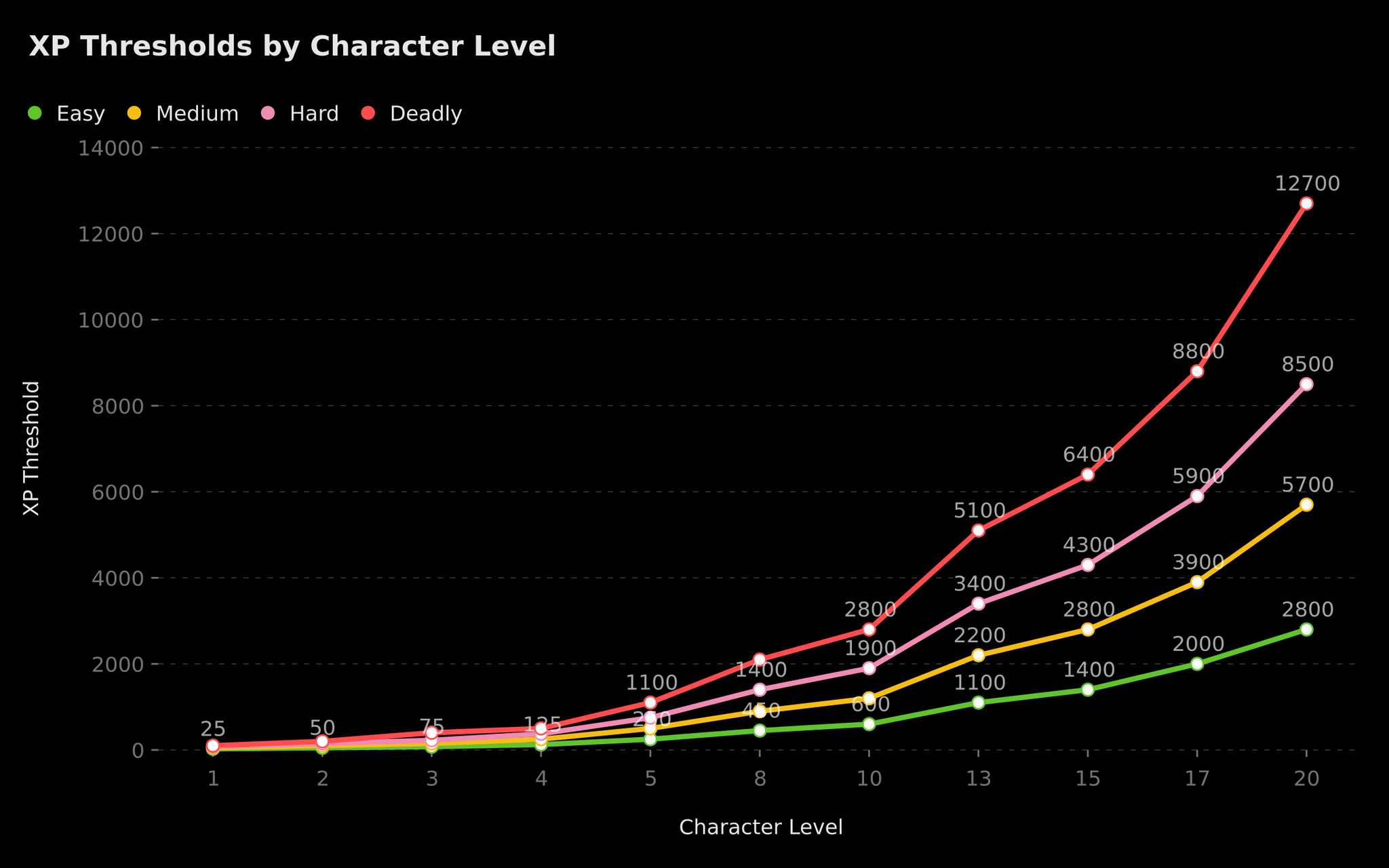
See XP Thresholds by Character Level table for exact values.
Step 2: Calculate Party XP Thresholds
Add up each character’s thresholds for each difficulty category.
Example: Party of three 3rd-level characters + one 2nd-level character:
- Easy: 275 XP (75 + 75 + 75 + 50)
- Medium: 550 XP
- Hard: 825 XP
- Deadly: 1,400 XP
Step 3: Total the Monsters’ XP
Add up the base XP for all monsters in the encounter (from their stat blocks).
Step 4: Apply Encounter Multiplier
Multiple monsters are more dangerous due to action economy (more attacks per round). Multiply total monster XP by a multiplier based on count:
| Number of Monsters | Multiplier |
|---|---|
| 1 | × 1 |
| 2 | × 1.5 |
| 3–6 | × 2 |
| 7–10 | × 2.5 |
| 11–14 | × 3 |
| 15+ | × 4 |
Party Size Adjustments:
- Fewer than 3 PCs: Use next highest multiplier (e.g., ×1.5 for 1 monster)
- 6+ PCs: Use next lowest multiplier (e.g., ×0.5 for 1 monster)
Important: This adjusted XP is only for difficulty assessment. Award base XP to players.
Example: 4 monsters worth 500 XP total → 500 × 2 = 1,000 adjusted XP.
Step 5: Compare to Thresholds
Compare adjusted XP to the party’s thresholds. The highest threshold lower than the adjusted XP determines difficulty.
Example: 1,000 adjusted XP vs. the example party → Hard encounter (Hard threshold: 825 XP; Deadly threshold: 1,400 XP).
The Adventuring Day
Expected capacity: 6-8 medium or hard encounters before a long rest (more easy, fewer deadly).
Each character level has a daily XP budget. Multiply by party size for total budget.
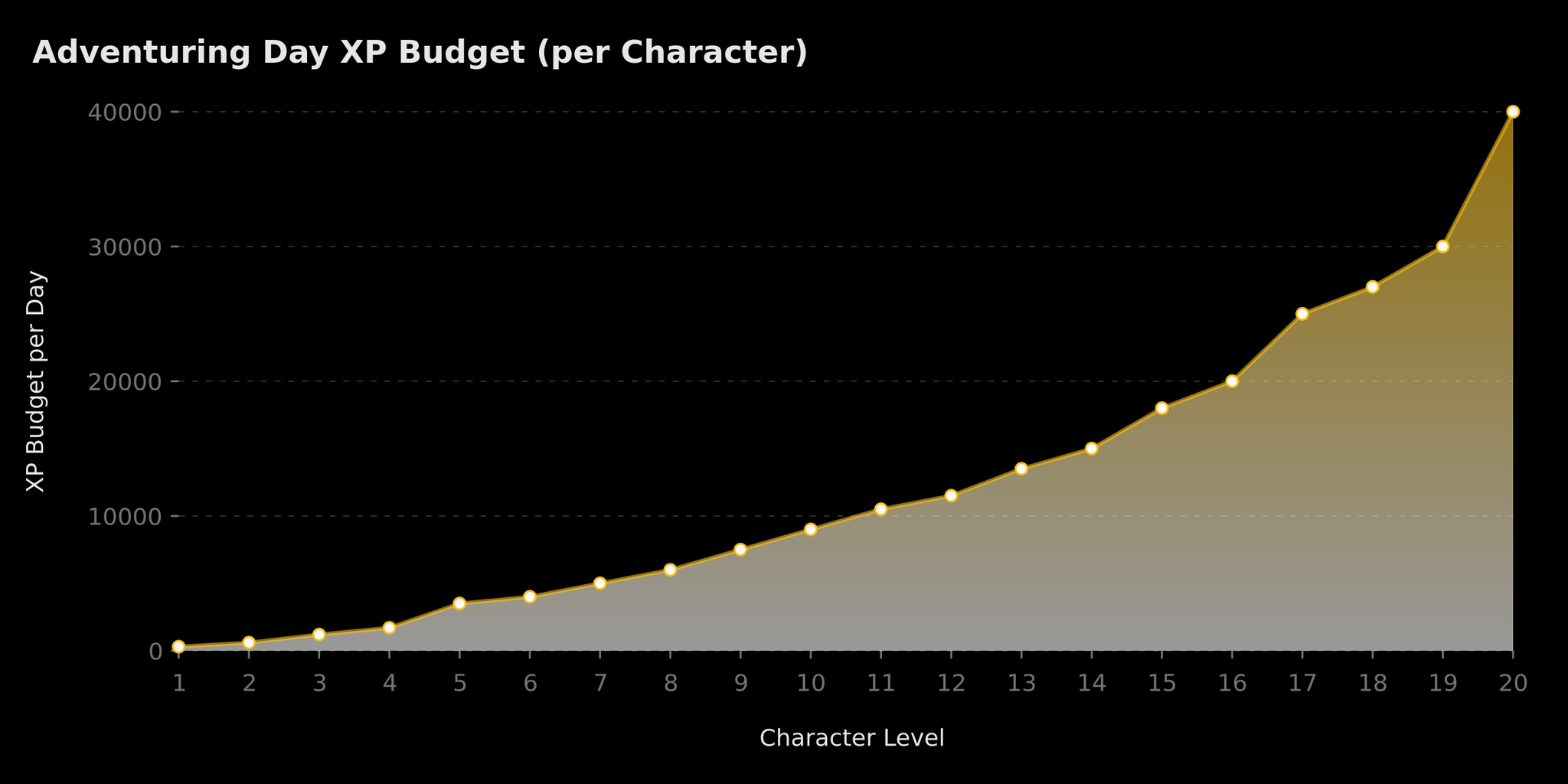
See Adventuring Day XP table for exact values.
Multipart Encounters: If the party can’t short rest between waves, and the adjusted XP exceeds one-third of the daily budget, the encounter is tougher than the sum of its parts.
CR Calculation for Homebrew Monsters
Calculate a monster’s CR by averaging its Defensive CR (survivability) and Offensive CR (damage output). Based on DMG p.274-282.
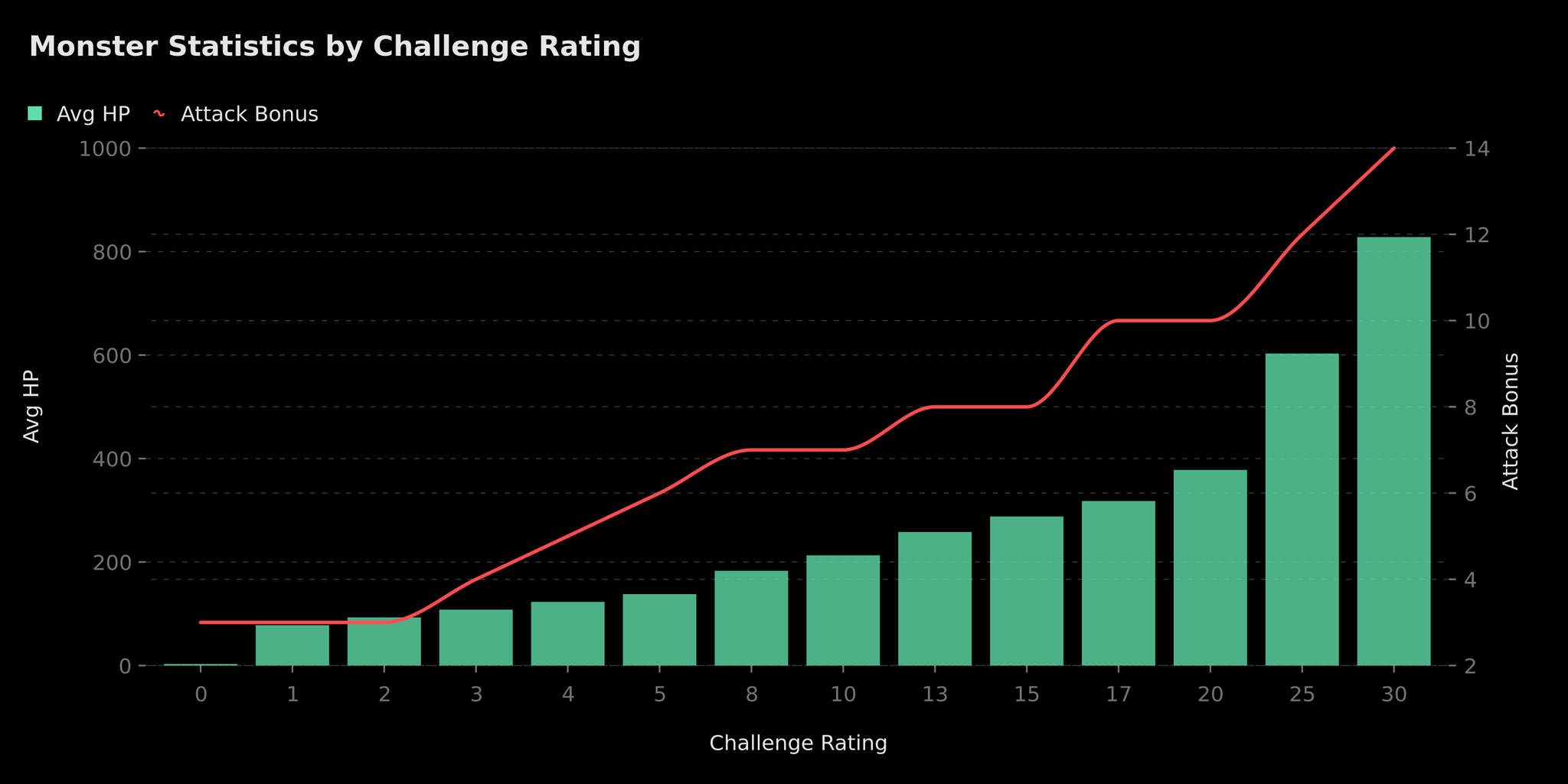
Defensive CR
-
Calculate Effective HP
- Start with actual HP
- Apply multipliers for traits:
- Resistance to common damage (nonmagical B/P/S): ×1.5
- Multiple resistances: ×2
- Immunity to common damage: ×2
- Regeneration: Add 3× regeneration per round (over 3 rounds)
-
Find HP-based CR
- Look up effective HP on the Monster Statistics by CR table
- Note the provisional CR
-
Adjust for AC
- Check expected AC for that CR
- For every 2 points actual AC differs from expected:
- Higher AC: Increase defensive CR by 1
- Lower AC: Decrease defensive CR by 1
-
Final Defensive CR
- Average the HP-based and AC-adjusted CR
Example:
- Monster has 100 HP (CR 2 range), AC 13
- Expected AC for CR 2: 13
- No adjustment needed → Defensive CR 2
Offensive CR
-
Calculate Damage Per Round (DPR)
- Use the monster’s most damaging 3-round sequence:
- DPR = (Round 1 damage + Round 2 damage + Round 3 damage) / 3
- Assume all attacks hit
- Include special abilities (breath weapons, spells)
- Don’t include situational damage (e.g., only vs. specific creature types)
- Use the monster’s most damaging 3-round sequence:
-
Find DPR-based CR
- Look up DPR on the Monster Statistics by CR table
-
Adjust for Attack Bonus or Save DC
- Check expected attack bonus / save DC for that CR
- For every 2 points actual value differs from expected:
- Higher: Increase offensive CR by 1
- Lower: Decrease offensive CR by 1
-
Adjust for Special Traits
- Add to offensive CR for powerful abilities:
- Save-or-die effects: +2 to +4
- Flight (vs. melee party): +1 to +2
- Spellcasting with crowd control: +1 to +2
- Add to offensive CR for powerful abilities:
-
Final Offensive CR
- Average DPR-based and attack/save-adjusted CR, plus trait modifiers
Example:
- Monster deals average 18 DPR (CR 2 range)
- Attack bonus +3 (expected for CR 2)
- No special traits → Offensive CR 2
Final CR
Final CR = (Defensive CR + Offensive CR) / 2, rounded to nearest 1/8.
If Defensive and Offensive CR differ by 2+: The monster is imbalanced. Consider using the higher value, or redesign for balance.
Example: Defensive CR 2 + Offensive CR 2 → Final CR 2 (450 XP)
Practical Guidance & Limitations
CR Guidelines by Level
- 1st level: Be cautious with CR 1/2+ monsters (single hit can drop a PC)
- 2nd-4th level: CR roughly = party level for one monster vs. one PC
- 5th+ level: A monster with CR = party level challenges four characters
Action Economy Matters
Multiple weaker monsters > single strong monster due to more actions/turn.
Rule of thumb: Have at least one monster per four PCs (e.g., six 5th-level PCs → start with two CR 5 creatures, not one CR 10).
Even a CR 20+ solo monster struggles against a coordinated high-level party.
Situational Modifiers
Increase encounter difficulty by one step (Easy → Medium) if:
- Whole party is surprised
- Enemy has cover / PCs don’t
- PCs can’t see enemy
- PCs take environmental damage
- PCs are restrained, climbing, or mobility-impaired
Decrease difficulty if PCs have advantages enemies don’t.
Known Limitations of the CR System
-
Assumes 4-person party of equal level with average optimization
-
Ignores:
- Magic items
- Player skill and tactics
- Party composition (all melee vs. all casters)
- Environmental factors
- Creature synergies
- Nova potential (action surge, smites, high-level spells)
-
Action economy dominates: Multipliers try to account for this, but AoE spells (Fireball, Hypnotic Pattern) swing encounters wildly
-
CR doesn’t scale linearly: A CR 10 monster is NOT equivalent to ten CR 1 monsters
-
2024 DMG removed encounter multipliers entirely — a tacit admission the system was flawed
Best practice: Use CR as a starting point, then test encounters and adjust for your specific table’s power level.
Tools & Resources
Online Calculators
- Kobold+ Fight Club: Modern encounter builder with vast monster library, source filtering, 2014/2024 rules
- 5e.tools CR Calculator: Homebrew monster CR calculation with automatic stat validation
- DnD Beyond Encounter Builder: Official tool with licensed content
Building Encounters “On Budget”
Use party thresholds as a spending budget:
- Decide desired difficulty (Easy, Medium, Hard, Deadly)
- Select monsters with adjusted XP between that threshold and the next
- Remember groups cost more due to multipliers
Example: Party threshold is 550 Medium / 825 Hard
- One CR 3 creature (700 XP, no multiplier) = Medium ✓
- Two CR 2 creatures (450 × 2 = 900 base, ×1.5 = 1,350 adjusted) = Deadly ✗
Quick CR Benchmarks
CR roughly equals:
- Number of 1st-level characters needed for a medium fight (CR 1 = four 1st-level PCs)
- Party level for a medium fight (at 5th+ level, CR 5 = medium for four 5th-level PCs)
XP per CR:
- CR 1/8 = 25 XP
- CR 1/4 = 50 XP
- CR 1/2 = 100 XP
- CR 1 = 200 XP
- CR 5 = 1,800 XP
- CR 10 = 5,900 XP
- CR 20 = 25,000 XP
Reference Tables
XP Thresholds by Character Level
| Level | Easy | Medium | Hard | Deadly |
|---|---|---|---|---|
| 1st | 25 | 50 | 75 | 100 |
| 2nd | 50 | 100 | 150 | 200 |
| 3rd | 75 | 150 | 225 | 400 |
| 4th | 125 | 250 | 375 | 500 |
| 5th | 250 | 500 | 750 | 1,100 |
| 6th | 300 | 600 | 900 | 1,400 |
| 7th | 350 | 750 | 1,100 | 1,700 |
| 8th | 450 | 900 | 1,400 | 2,100 |
| 9th | 550 | 1,100 | 1,600 | 2,400 |
| 10th | 600 | 1,200 | 1,900 | 2,800 |
| 11th | 800 | 1,600 | 2,400 | 3,600 |
| 12th | 1,000 | 2,000 | 3,000 | 4,500 |
| 13th | 1,100 | 2,200 | 3,400 | 5,100 |
| 14th | 1,250 | 2,500 | 3,800 | 5,700 |
| 15th | 1,400 | 2,800 | 4,300 | 6,400 |
| 16th | 1,600 | 3,200 | 4,800 | 7,200 |
| 17th | 2,000 | 3,900 | 5,900 | 8,800 |
| 18th | 2,100 | 4,200 | 6,300 | 9,500 |
| 19th | 2,400 | 4,900 | 7,300 | 10,900 |
| 20th | 2,800 | 5,700 | 8,500 | 12,700 |
Adventuring Day XP
| Level | Adjusted XP per Day per Character |
|---|---|
| 1st | 300 |
| 2nd | 600 |
| 3rd | 1,200 |
| 4th | 1,700 |
| 5th | 3,500 |
| 6th | 4,000 |
| 7th | 5,000 |
| 8th | 6,000 |
| 9th | 7,500 |
| 10th | 9,000 |
| 11th | 10,500 |
| 12th | 11,500 |
| 13th | 13,500 |
| 14th | 15,000 |
| 15th | 18,000 |
| 16th | 20,000 |
| 17th | 25,000 |
| 18th | 27,000 |
| 19th | 30,000 |
| 20th | 40,000 |
Usage: Multiply by party size. Example: Four 5th-level characters = 14,000 XP/day.
Monster Statistics by CR
Expected values for homebrew monster design. Use effective HP/AC/DPR (after trait adjustments).
| CR | Prof Bonus | AC | HP Range | Attack Bonus | DPR Range | Save DC |
|---|---|---|---|---|---|---|
| 0 | +2 | ≤13 | 1–6 | ≤+3 | 0–1 | ≤13 |
| 1/8 | +2 | 13 | 7–35 | +3 | 2–3 | 13 |
| 1/4 | +2 | 13 | 36–49 | +3 | 4–5 | 13 |
| 1/2 | +2 | 13 | 50–70 | +3 | 6–8 | 13 |
| 1 | +2 | 13 | 71–85 | +3 | 9–14 | 13 |
| 2 | +2 | 13 | 86–100 | +3 | 15–20 | 13 |
| 3 | +2 | 13 | 101–115 | +4 | 21–26 | 13 |
| 4 | +2 | 14 | 116–130 | +5 | 27–32 | 14 |
| 5 | +3 | 15 | 131–145 | +6 | 33–38 | 15 |
| 6 | +3 | 15 | 146–160 | +6 | 39–44 | 15 |
| 7 | +3 | 15 | 161–175 | +6 | 45–50 | 15 |
| 8 | +3 | 16 | 176–190 | +7 | 51–56 | 16 |
| 9 | +4 | 16 | 191–205 | +7 | 57–62 | 16 |
| 10 | +4 | 17 | 206–220 | +7 | 63–68 | 16 |
| 11 | +4 | 17 | 221–235 | +8 | 69–74 | 17 |
| 12 | +4 | 17 | 236–250 | +8 | 75–80 | 17 |
| 13 | +5 | 18 | 251–265 | +8 | 81–86 | 18 |
| 14 | +5 | 18 | 266–280 | +8 | 87–92 | 18 |
| 15 | +5 | 18 | 281–295 | +8 | 93–98 | 18 |
| 16 | +5 | 18 | 296–310 | +9 | 99–104 | 18 |
| 17 | +6 | 19 | 311–325 | +10 | 105–110 | 19 |
| 18 | +6 | 19 | 326–340 | +10 | 111–116 | 19 |
| 19 | +6 | 19 | 341–355 | +10 | 117–122 | 19 |
| 20 | +6 | 19 | 356–400 | +10 | 123–140 | 19 |
| 21 | +7 | 19 | 401–445 | +11 | 141–158 | 20 |
| 22 | +7 | 19 | 446–490 | +11 | 159–176 | 20 |
| 23 | +7 | 19 | 491–535 | +11 | 177–194 | 20 |
| 24 | +7 | 19 | 536–580 | +12 | 195–212 | 21 |
| 25 | +8 | 19 | 581–625 | +12 | 213–230 | 21 |
| 26 | +8 | 19 | 626–670 | +12 | 231–248 | 21 |
| 27 | +8 | 19 | 671–715 | +13 | 249–266 | 22 |
| 28 | +8 | 19 | 716–760 | +13 | 267–284 | 22 |
| 29 | +9 | 19 | 761–805 | +13 | 285–302 | 22 |
| 30 | +9 | 19 | 806–850 | +14 | 303–320 | 23 |
Note: This table is derived from DMG Chapter 9. Proficiency bonus shown for reference (adds to attack rolls, save DCs, skill checks).
Sources
Primary Sources
- Dungeon Master’s Guide (2014), Chapter 13: “Building Combat Encounters” (p.82-85)
- Dungeon Master’s Guide (2014), Chapter 9: “Creating a Monster” (p.274-282)
- D&D Basic Rules (2014): Building Combat Encounters — Official SRD version
Secondary Sources
- Sly Flourish: “5e Encounter Building” — Analysis of DMG system with practical simplifications
- Sly Flourish: “What Does CR Really Mean?” — CR calculation walkthrough
- The DM Lair: “How to Use the Adventuring Day Rules” — Adventuring day budget application
- Blog of Holding: “2024 DMG Encounter Building Changes” — Comparison to 2024 edition (which removed multipliers)
Tools
- Kobold+ Fight Club — Modern encounter builder
- 5e.tools CR Calculator — Homebrew monster CR calculation
- IADnDMN CR Calculator — Alternative CR calculator with trait adjustments