Cybernetic art explores feedback, self-organization, and participatory systems through aesthetic practice. The field splits into two competing visions: cybernetics as liberation (self-organization, distributed control, participatory feedback) versus cybernetics as domination (military origins, surveillance, managed participation).
The best work doesn’t resolve this tension — it inhabits it.
Gallery of Key Works
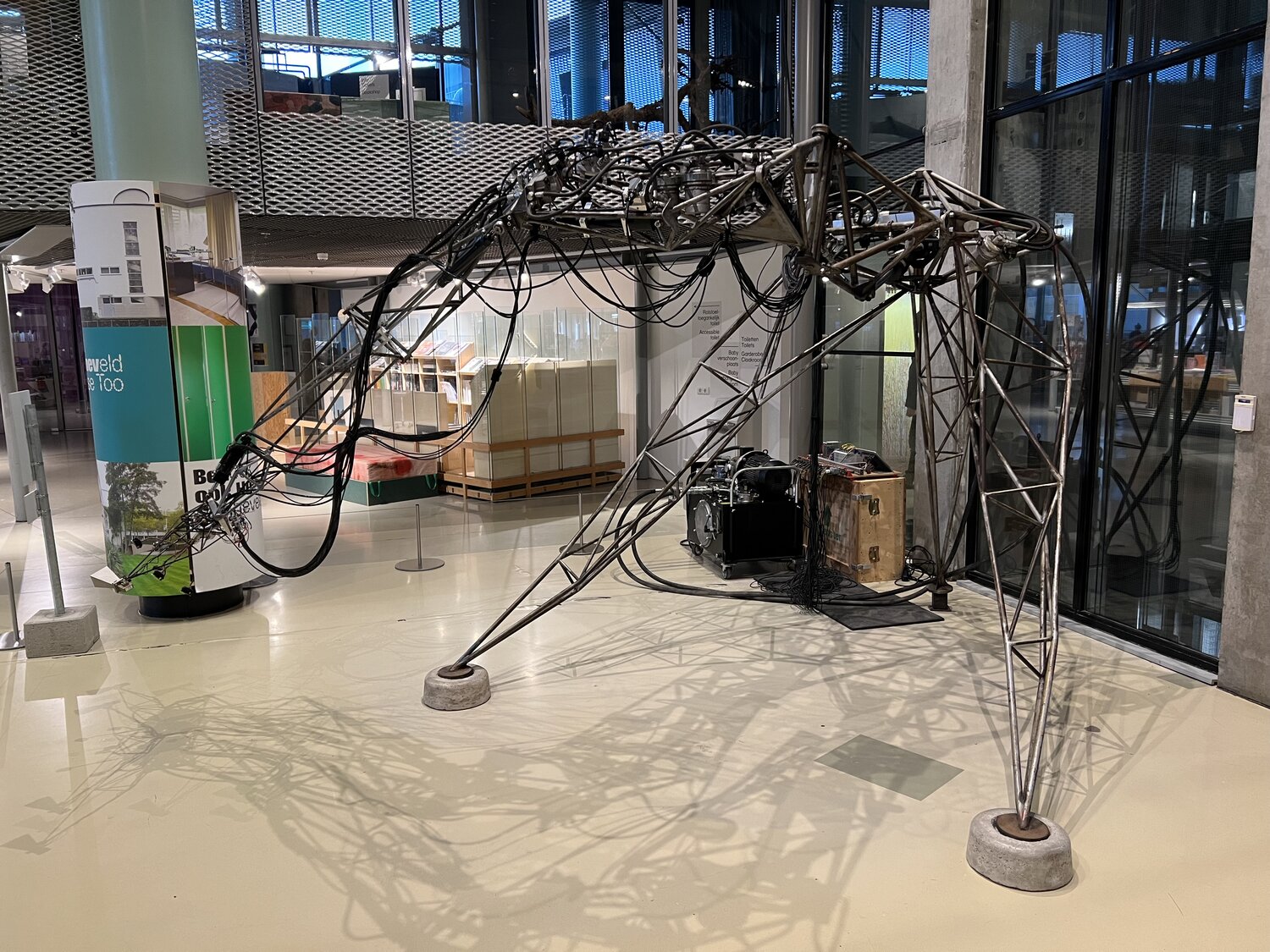 Edward Ihnatowicz, Senster, 1970. Welded steel tubing, computer-controlled hydraulics, 4+ m tall. Commissioned by Philips for the Evoluon, Eindhoven. Microphones and Doppler radar enabled the sculpture to approach quiet sounds and retreat from loud ones. Children shouted at it and threw things. A powerful demonstration that machine behavior creates empathy without anthropomorphism. Photo: Nieuwe Instituut REBOOT exhibition, 2023.
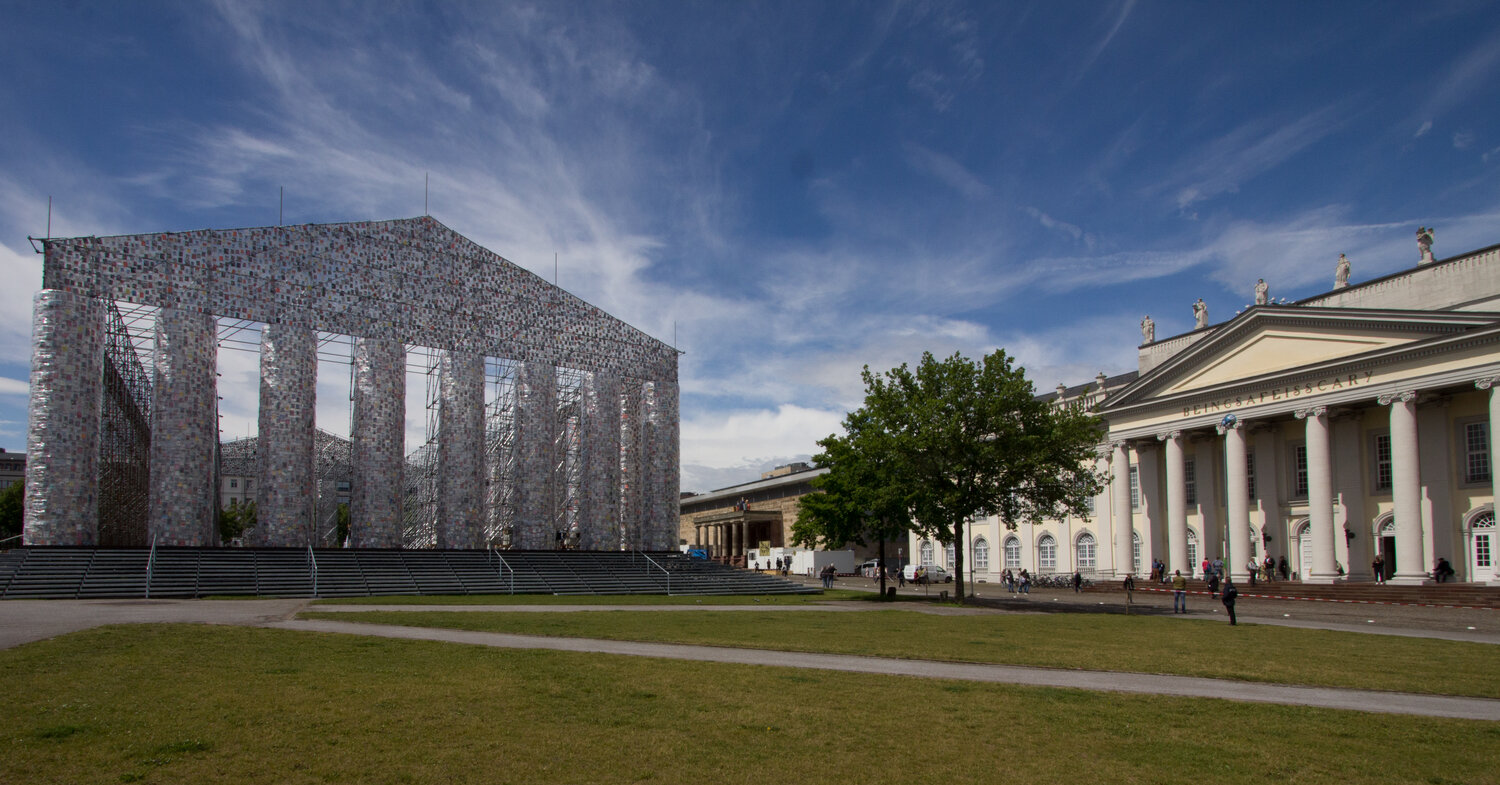 Marta Minujín, The Parthenon of Books, documenta 14, Kassel, 2017. Metal frame covered with 100,000+ banned books donated by the public. Built on Friedrichsplatz—the exact site of the 1933 Nazi book burning. A recreation of Minujín’s 1983 Buenos Aires version celebrating democracy’s return after Argentina’s dictatorship. Upon conclusion, all books were redistributed to visitors: a system for redistributing suppressed knowledge. Photo: Olaf Kosinsky, CC BY-SA.
The Recurring Question
Can participatory systems art be genuinely liberatory, or does it merely simulate agency within pre-designed constraints?
This question runs from the 1960s Situationist International’s attacks on interactive installations to contemporary platform cooperativism. The answer depends on whether the system’s structure is reconfigurable by participants or merely invites interaction within fixed boundaries.
Pioneers: Art as Cybernetic System
Gordon Pask — Conversation as System
Gordon Pask (1928-1996) bridged cybernetics, architecture, art, and pedagogy. His Musicolour (1953) responded to musicians but would get “bored” if they repeated themselves, forcing a genuine feedback conversation. The system controlled colored lights that shifted in response to pitch, rhythm, and volume—but crucially, it learned to ignore repetition, demanding genuine improvisation from performers. Musicians found themselves in a duet with the machine.
His Colloquy of Mobiles (1968) presented five suspended sculptural constructions—aluminum-frame geometric forms with mirrors, lights, and sensors—that “spoke” to each other via light beams. When gallery visitors shone flashlights at them, they entered the conversation, becoming participants in a networked dialogue between human and machine agents. The work modeled multi-agent self-organization as sculpture—a distributed system with no central authority, only reciprocal influence.
Pask also served on the cybernetics subcommittee for Cedric Price and Joan Littlewood’s Fun Palace (1961-74), the most radical architectural application of cybernetic principles ever proposed: a building with no fixed program whose users determined its form. A proto-hackerspace, proto-commons. Never built, but influential on participatory architecture worldwide.
Nicolas Schöffer — Autonomous Machines
Nicolas Schöffer (1912-1992) created CYSP I (1956), the first explicitly cybernetic sculpture — a mobile construction of polished metal plates mounted on a wheeled base. Built by Philips, it used photoelectric cells and microphones to respond autonomously to its environment: moving toward bright colors and loud sounds, retreating from darkness and silence. The sculpture “danced” at the Sarah Bernhardt Theatre in Paris, improvising movements in response to music and lighting. Its spindly metal frame and rotating reflective planes created kinetic light patterns—a machine that performed rather than merely functioned.
He envisioned a “Cybernetic City” where art would be fully integrated into public systems, and designed SCAM sculptures (Structures Cybernétiques Autodéterminées Modifiables) that anyone could disassemble and reassemble—modular kinetic constructions with interchangeable parts. Proto-open-source aesthetics: the artwork as reconfigurable platform rather than fixed object.
Roy Ascott — Process Over Object
Roy Ascott (b. 1934) is the key theorist of cybernetic and telematic art. His 1964 essay “Behaviourist Art and the Cybernetic Vision” fused cybernetics with participatory art. Founded the Groundcourse at Ealing Art College (alumni include Brian Eno), based on “cybernetic thinking — not the object but the process, not art as a thing but art as a system.”
Edward Ihnatowicz — Empathy Without Anthropomorphism
Edward Ihnatowicz (1926-1988) is lesser-known but extraordinary. His Senster (1970) was a 15-foot computer-controlled robotic sculpture that approached quiet sounds and retreated from loud ones. Children shouted at it and threw things. A powerful demonstration that machine behavior creates empathy without anthropomorphism.
Stephen Willats — Social Cybernetics
Stephen Willats (b. 1943) may be the most politically committed of the group. He used cybernetic feedback concepts to create participatory social art with tower block residents and punk communities. Founded Control Magazine (1965-). Published The Artist as Instigator of Changes in Social Cognition and Behaviour (1973). Explicitly anti-hierarchical — a key bridge between cybernetics, social practice art, and anarchist organizing.
The Landmark Exhibition
Cybernetic Serendipity (ICA London, 1968), curated by Jasia Reichardt, featured Pask, Ihnatowicz, Nam June Paik, Jean Tinguely, and dozens more. It defined cybernetic art as a public phenomenon.
But Gustav Metzger participated and sharply criticized it for ignoring cybernetics’ military origins — an essential counter-narrative.
The Critique: Systems Art and Power
Gustav Metzger — Destructive Systems
Gustav Metzger (1926-2017) invented Auto-Destructive Art and explicitly listed cybernetics and feedback among his materials. A Holocaust survivor who saw destructiveness at the core of all systems — including the cybernetic ones. Called an Art Strike in 1974, proposing artists withdraw labor from capitalism entirely.
The missing link between cybernetics, anti-capitalism, and the critique of techno-utopianism.
Hans Haacke — Social Systems Exposed
Hans Haacke (b. 1936) began with physical systems works like Condensation Cube (1965)—a sealed acrylic box partially filled with water. Temperature changes cause water to evaporate, condense on the walls, and trickle down in unpredictable patterns. The cube is a closed thermodynamic system made visible: energy in (ambient temperature), water cycling between states, emergent patterns no one controls. Beautiful, autonomous, indifferent.
Then he pivoted to exposing social systems—real estate ownership, corporate sponsorship, museum governance. Works like Shapolsky et al. Manhattan Real Estate Holdings (1971) displayed photographs and data documenting a network of slum properties, revealing the hidden economic systems structuring New York’s housing crisis. The Guggenheim cancelled his exhibition rather than display it.
This shift from “natural” to “social” systems showed that you cannot do systems art without confronting who controls the system. Both works map feedback loops, but only one names the landlords.
Jack Burnham — Disillusionment
Jack Burnham (1931-2019) declared art’s shift “from an object-oriented to a systems-oriented culture” in his 1968 essay “Systems Esthetics.” Later became disillusioned by the military-industrial co-optation of systems thinking and renounced his own theory. His trajectory is worth studying precisely for its failure — proof that systems art must address power to remain radical.
The Situationist Challenge
The Situationist International (1957-1972) never used cybernetic language, but their practices parallel systems thinking: détournement as recombinant systems, psychogeography as mapping emergent urban patterns, critique of the spectacle as analyzing a self-reproducing feedback system of images.
Critically, the SI attacked GRAV’s interactive installations (a Paris-based collective building interactive labyrinths) for constraining participation within pre-designed options — a debate about whether participatory systems art is genuinely liberatory or merely simulates agency.
GRAV and the Limits of Interactivity
Groupe de Recherche d’Art Visuel (GRAV), founded in Paris in 1960, created participatory installations designed to democratize art by making viewers into active participants rather than passive spectators. Their 1963 exhibition at the Biennale de Paris featured corridors lined with Op Art patterns, rotating mirrors, distorting lenses, flickering lights, and vibrating platforms—immersive environments where visitors triggered visual and kinetic effects through movement and touch.
The installations operated as closed cybernetic loops: visitor enters → sensor detects → mechanism activates → pattern changes → visitor responds. Julio Le Parc designed light boxes with rotating colored discs that viewers could manipulate via buttons and levers. François Morellet created grids of neon tubes that blinked in preprogrammed sequences, appearing random but following predetermined algorithms. Horacio Garcia-Rossi built rooms where footsteps triggered color shifts across walls. Each work invited interaction while constraining it within the artist’s predetermined system.
The SI’s objection was fundamental: GRAV’s “participation” was simulation. Visitors could press buttons, trigger lights, walk through mazes—but they could not redesign the maze itself. The range of possible actions was predetermined by the artists. This was participatory within limits, interactive within boundaries—precisely the kind of managed participation that cybernetic systems excel at providing.
The debate anticipated contemporary critiques of digital platforms that offer “choice” within algorithmically constrained possibility spaces. GRAV’s labyrinths are the ancestors of social media interfaces: you can click, scroll, react, share—but you cannot alter the fundamental architecture that shapes those interactions.
Still unresolved.
For detailed analysis of how SI critique relates to cybernetic control systems, see Situationist International and Cybernetics.
Latin American Thread: Design for Autonomy
Gui Bonsiepe and the Cybersyn Operations Room
Gui Bonsiepe (b. 1934), trained at HfG Ulm under Max Bense and Tomás Maldonado, led the design team for the Cybersyn Operations Room under Allende. The room’s futuristic tulip-chair interface was designed to be accessible to workers without computer experience.
The entire project is arguably the most important intersection of cybernetics, design, and radical politics in the twentieth century. Destroyed in the coup of September 11, 1973.
Venezuelan Kinetic Art
Jesús Rafael Soto (1923–2005), Carlos Cruz-Diez (1923–2019), Alejandro Otero (1921–1990) created immersive, perception-based works relying on viewer movement to activate optical phenomena.
Soto’s Penetrables (begun 1967) are forests of hanging nylon threads—thousands of vertical strands suspended from the ceiling, dense enough to form visual planes but loose enough to walk through. As you move into them, your body disrupts the parallel lines, creating rippling interference patterns. The sculpture only exists in the interaction: static, it’s merely threads; activated by a moving body, it becomes dynamic optical architecture. Systems art in physical form—the artwork is the feedback loop between viewer and material.
Cruz-Diez’s Chromosaturation environments (begun 1965) immerse viewers in chambers flooded with pure colored light—red, green, blue. As you move between chambers, afterimages create false colors, demonstrating that color is relational and generated by the perceiving eye, not inherent in surfaces. A phenomenological demonstration built as architectural space.
But Marxist critic Marta Traba savaged cinetismo’s absorption into Venezuela’s oil-boom state architecture, raising sharp questions about whether participatory art can be co-opted. When immersive perceptual experiments become lobby decoration for oil company headquarters, what remains of their radical potential? Worth sitting with.
Marta Minujín — Redistributing Knowledge
Marta Minujín (b. 1943) consistently creates emergent social systems through participatory structures. Her Parthenon of Books (1983/2017) assembled 30,000 books banned under dictatorship into a temple that was then dismantled and distributed to the public — a system for redistributing suppressed knowledge.
Contemporary Collectives: Structure as Artwork
ruangrupa and Lumbung
ruangrupa, the Indonesian collective that curated documenta 15 (2022) using lumbung — a communal rice barn model based on trust, sufficiency, and shared governance. They ran one of the world’s most prestigious art exhibitions as an experiment in commoning.
A radical contemporary example of cooperative organizational structure as the artwork itself.
Tactical Media and Net.Art
Tactical media (c. 1993-2003) synthesized Situationist détournement with digital network culture. Key groups include Critical Art Ensemble and The Yes Men.
The net.art movement (Vuk Ćosić, Olia Lialina, JODI, irational.org) was inherently collective and commons-oriented, using the early web as a distributed, non-hierarchical medium.
Platform Cooperativism
Art.coop and the solidarity economy art movement (2021-present) explicitly synthesizes cooperative economics and cultural production. Connected projects include:
- Justseeds — worker-owned radical art print collective
- Ampled — cooperative Patreon for musicians
- Means TV — worker-owned streaming
The organizational dimension of cybernetic art realized as economic infrastructure.
Olivier Auber — Persistent Systems
Olivier Auber’s Poietic Generator (1986-present) is a quiet, persistent online experiment where participants collaboratively create visual patterns on a shared grid in real time — a living demonstration of self-organization and emergent aesthetics, running for nearly forty years.
Films: Governance Made Visible
Essential Documentaries
The Battle of Chile (Patricio Guzmán, 1975-1979) — Three-part epic on Allende’s democratic socialist government and the coup that destroyed it. Part 3, “Popular Power,” documents thousands of self-governing local committees — the closest real-world analog to what Beer was wiring together with Cybersyn. Widely regarded as one of the greatest documentaries ever made.
Das Netz (Lutz Dammbeck, 2003) — A German essay-documentary that maps hidden connections between the Macy Conferences, Norbert Wiener, Heinz von Foerster, Stewart Brand, counterculture, and the Unabomber. The best single film on the political genealogy of cybernetics — who built it, who funded it, and whose interests it served.
All Watched Over by Machines of Loving Grace (Adam Curtis, 2011) — Three-part BBC series tracing how cybernetic and systems-theory ideas migrated from Wiener through Silicon Valley to reshape politics. Episode 2 tracks how ecosystem thinking was applied to communes, networks, and societies, with results Curtis finds deeply ambiguous.
Shift Change (Mark Dworkin & Melissa Young, 2012) — The definitive documentary on the Mondragon cooperatives and U.S. worker co-ops. Unprecedented access to the Basque network where 60% of residents are employee-owners. Practical, grounded, unglamorous.
Vivir la Utopía (Juan A. Gamero, 1997) — Surviving participants in the Spanish Civil War’s anarchist revolution describe collectivizing factories, farms, and entire towns across Catalonia and Aragon. One of the most extensive experiments in anarchist self-governance in history, told by the people who lived it.
Narrative Films: Collective Decision-Making
La Commune (Paris, 1871) (Peter Watkins, 2000) — A six-hour reconstruction of the Paris Commune performed by 220 non-professional actors from the Paris suburbs. Watkins invents “Commune TV” versus “Versailles TV” to expose media framing in real time. A masterclass in collective filmmaking about collective governance.
Land and Freedom (Ken Loach, 1995) — A young English communist joins the POUM militia in Spain and experiences the agonizing tensions between Stalinist centralization and anarchist self-organization. The village assembly scene — where peasants debate collectivization in real time — is one of cinema’s most vivid depictions of direct democratic decision-making.
Flow (Gints Zilbalodis, 2024) — An animated film with no dialogue: animals of different species must cooperate to survive a flooding world. A wordless parable of mutual aid and emergent cooperation without hierarchy. Oscar-nominated.
The Pattern: Design vs. Discovery
The recurring tension across all four categories is the same one: cybernetics as liberation versus cybernetics as control.
Metzger, the Situationists, Haacke, Adam Curtis, and Beer himself all confronted this. The most interesting work doesn’t resolve the tension — it inhabits it.
- Le Guin’s ambiguous utopia
- Beer’s Liberty Machine destroyed by a coup
- ruangrupa’s documenta experiment that drew both praise and fierce controversy
- Pask’s machines that got bored
These are all systems that acknowledge their own limits.
For an artist/maker, the productive insight isn’t that distributed systems are inherently good, but that the design of the system is itself the political act. The organizational form — how decisions get made, who participates, what gets fed back — is the art.
Further Resources
Complete Media Guide
agent/artifacts/research/cybernetics/media-digest.md — comprehensive guide including:
- Films (documentaries + narrative)
- Artists and movements
- Exhibitions
- Recommended entry points
Theoretical Survey
agent/artifacts/research/cybernetics/theoretical-survey.md — 60+ works across theory, fiction, and practice
Podcasts
The Santiago Boys (Evgeny Morozov, 2023) — Nine-part podcast on Project Cybersyn. The most deeply researched narrative account of the radical utopians around Allende, Beer, and Fernando Flores.
See Also
- Anarchism — political philosophy and cybernetic theory connections
- Visual Practice — principles for creating meaning through images