Die Brücke: The Bridge to German Expressionism
Gallery of Key Works
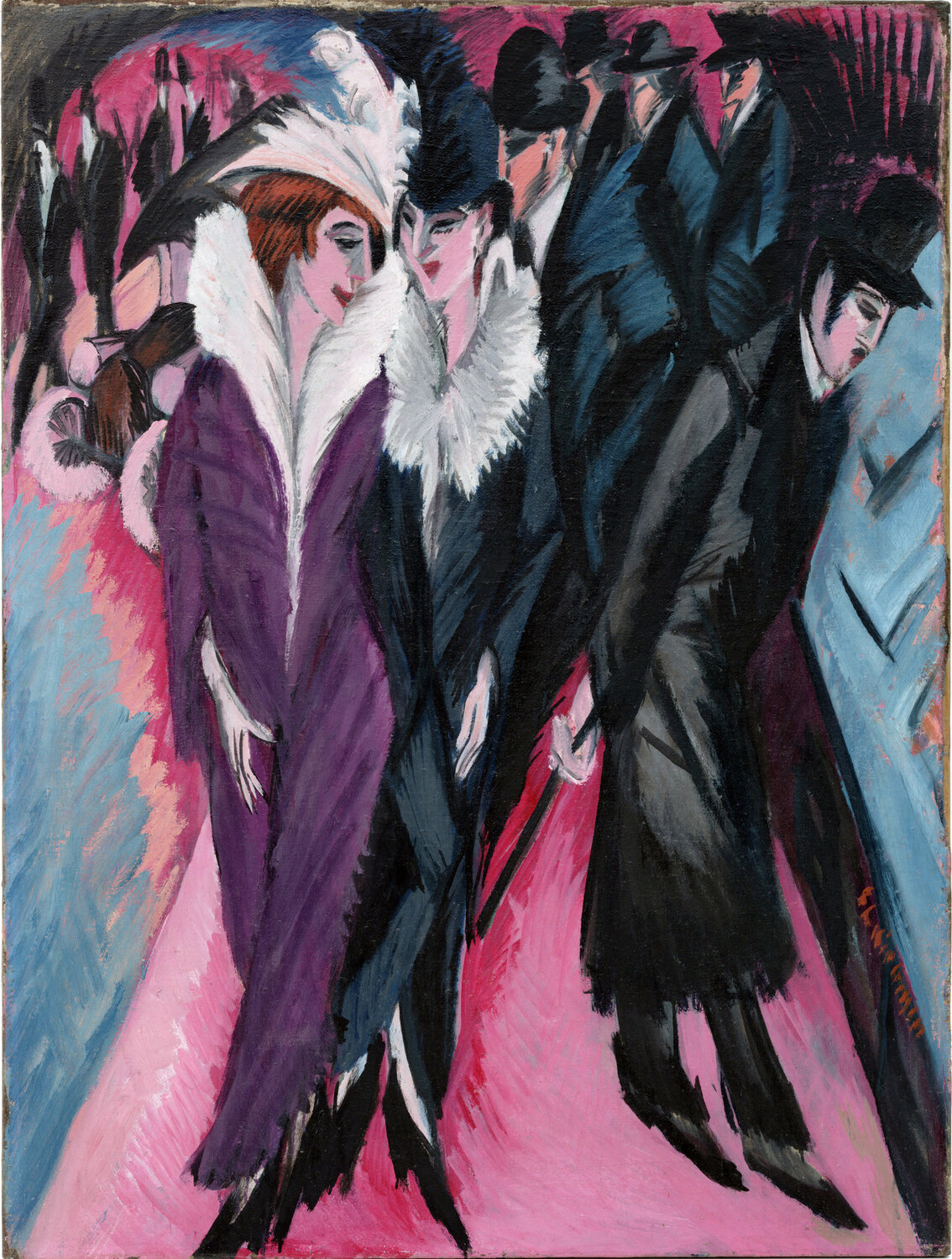 Ernst Ludwig Kirchner, Street, Berlin, 1913. Oil on canvas, 120.6 × 91.1 cm. Museum of Modern Art, New York. Two prostitutes dominate a vertiginous Berlin streetscape, their acid-colored forms sliding down the tilted picture plane. Kirchner’s anxious vision of metropolitan alienation and commodified sexuality became one of German Expressionism’s defining images.
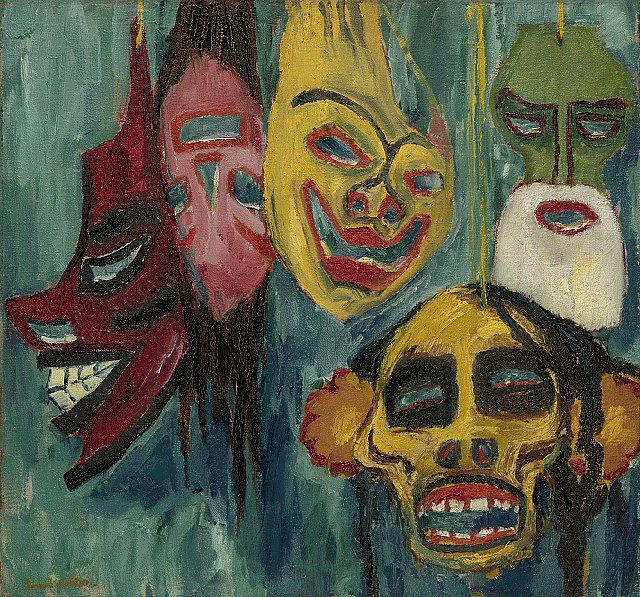 Emil Nolde, Masks, 1911. Oil on canvas, 73 × 77.5 cm. Nelson-Atkins Museum of Art, Kansas City. Grotesque faces derived from African, Oceanic, and carnival masks create what one critic called “a mocking chorus of alienation.” Nolde synthesized ethnographic study with jarring color—acid yellows against putrid greens, blood reds against corpse blues—to visualize modern psychological fragmentation.
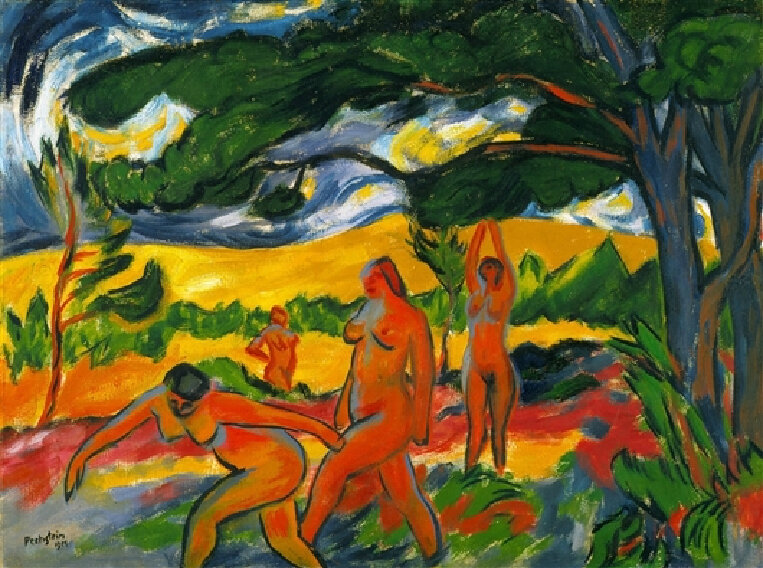 Max Pechstein, Under the Trees (Akte im Freien), 1911. Oil on canvas, 73.6 × 99 cm. Detroit Institute of Arts. Painted during a summer retreat to Nidden on the Curonian Peninsula, this celebration of naturism embodies Die Brücke’s anti-urban impulse. Bold orange tones for the nude figures contrast with dark greens of the overhanging trees, evoking an unspoiled existence free from industrial modernity.
Introduction
On June 7, 1905, four architecture students in Dresden founded an artist collective that would fundamentally reshape the trajectory of modern art. Die Brücke (The Bridge) emerged as the fountainhead of German Expressionism, a movement that prioritized raw emotional expression over academic naturalism, primitive directness over bourgeois refinement, and collective experimentation over individual careerism. The group’s eight-year existence (1905-1913) produced some of the most visceral and psychologically penetrating art of the early 20th century, establishing Germany as a major force in international modernism.
The name “Die Brücke” was proposed by Karl Schmidt-Rottluff and carried profound symbolic weight. Drawing inspiration from Friedrich Nietzsche’s Thus Spoke Zarathustra — “What is great in man is that he is a bridge and not an end” — the group positioned itself as a transitional force linking past and future. They sought to revive Germany’s rich artistic heritage (particularly the printmaking traditions of Dürer, Grünewald, and Cranach) while simultaneously forging a radical new visual language adequate to modern experience.
Founding Members and Their Backgrounds
The Dresden Four
Die Brücke’s founding quartet met as students at Dresden’s Königliche Technische Hochschule (Royal Technical University), where they studied architecture rather than fine art. This lack of formal artistic training would prove essential to their aesthetic revolution — unencumbered by academic conventions, they approached painting and printmaking with the directness of autodidacts.
Ernst Ludwig Kirchner (1880-1938) emerged as the group’s charismatic leader and most prolific theorist. Born in Aschaffenburg, Bavaria, Kirchner had studied architecture in Dresden from 1901, where he met Fritz Bleyl. Intensely ambitious and intellectually restless, Kirchner read voraciously — including Nietzsche, Dostoyevsky, and Whitman — and absorbed influences from Post-Impressionism, particularly Van Gogh and Munch, whose work he encountered in Dresden exhibitions. His apartment at Berliner Straße 65 became the group’s first communal studio, a converted butcher shop in a working-class neighborhood where the artists conducted nude life-drawing sessions that scandalized bourgeois sensibilities. Kirchner’s later authorship of the Chronik der Brücke (1913), which overstated his own centrality and denied foreign influences, precipitated the group’s dissolution.
Erich Heckel (1883-1970) became the group’s de facto business manager, leveraging his personable nature and art world connections to secure exhibition venues and patrons. Born in Döbeln, Saxony, Heckel met Schmidt-Rottluff in grammar school in 1902 before enrolling at the Technical Institute. His organizational acumen proved crucial to Die Brücke’s survival — he procured their first exhibition space at the Karl-Max Seifert lamp factory in 1906 and developed the “passive member” system whereby collectors received annual portfolios of prints in exchange for financial support. Artistically, Heckel favored a more lyrical, meditative approach than Kirchner’s nervous energy, particularly evident in his contemplative nudes and landscapes.
Karl Schmidt-Rottluff (1884-1976) was the youngest founding member and the group’s naming force. Born Karl Schmidt in Rottluff, Saxony (he hyphenated his birthplace to his surname in 1905), he brought an interest in coastal landscapes that would shape Die Brücke’s summer working retreats. Schmidt-Rottluff’s work demonstrated the most sustained engagement with primitivist form, featuring bold simplifications and angular geometries that anticipated his later flirtation with Cubist faceting. His 1910 Self-Portrait with Monocle exemplifies the group’s synthesis of bohemian self-fashioning with formal innovation — depicting himself as an intellectual outsider while deploying the flat color planes and dynamic brushwork that defined Die Brücke’s visual language.
Fritz Bleyl (1880-1966) was the first to depart, leaving in 1907 to start a family and pursue a conventional career. Though often marginalized in Die Brücke historiography, Bleyl designed the notorious poster for the group’s first exhibition — a semi-abstract nude deemed too sexually explicit by Dresden police, who banned it under pornography statutes. This censorship baptized Die Brücke into its role as cultural provocateur, confirming the group’s oppositional stance toward bourgeois morality.
Later Members and Fellow Travelers
The group’s expansion brought more established artists into the collective, though not all alignments proved sustainable.
Emil Nolde (1867-1956), thirteen years senior to Kirchner, was the first recruit in February 1906 after the founding members encountered his work at a Dresden exhibition. An already accomplished painter, Nolde brought mature coloristic skill and a northern Symbolist sensibility influenced by James Ensor and Munch. His 1911 Masks demonstrates his distinctive contribution — grotesque, carnivalesque faces that merge with the canvas surface, creating what one critic called “a mocking chorus of alienation.” However, Nolde’s independence clashed with Die Brücke’s rigid exhibition policies (members could not show outside the group without collective permission), and he departed shortly after joining, unwilling to subordinate his individual career to collective discipline.
Max Pechstein (1881-1955) joined in 1906 as the first member with formal academic training in painting, having studied at Dresden’s Royal Art Academy. Critics quickly identified him as the group’s “purest” painter, and he achieved the greatest commercial success during Die Brücke’s existence. Pechstein’s 1911 Under the Trees (Nudes in the Open) epitomizes the group’s naturist philosophy — vibrant, joyous nudes in landscape rendered with Fauve-like color intensity. He pioneered the move to Berlin in 1908, though his 1912 decision to exhibit with the Berlin Secession without group approval led to his expulsion, fracturing Die Brücke’s unity.
Otto Mueller (1874-1930) joined in 1910 after encountering the group at the Neue Sezession exhibition. Mueller brought a distinctive technical approach, working with distemper (pigment bound with glue) on burlap, creating matte, fresco-like surfaces. His elongated, languorous nudes suggest a more classicizing impulse than his colleagues’ aggressive angularity, though his commitment to primitivism and naturism aligned perfectly with Die Brücke’s ethos.
Cuno Amiet, Akseli Gallen-Kallela, Kees van Dongen, Franz Nölken, and Bohumil Kubišta also held membership at various points, reflecting Die Brücke’s ambition for international reach, though most affiliations proved short-lived.
Key Artistic Principles and Techniques
Anti-Academic Radicalism
Die Brücke’s 1906 manifesto, authored and printed as a woodcut by Kirchner, announced their rebellion against established aesthetic norms:
“With faith in evolution, in a new generation of creators and appreciators, we call upon all young people to rally. And as young people, who embody the future, we want to free our lives and limbs from the long-established powers of old. Anyone who realises his creative drive directly and genuinely is one of us.”
This declaration of generational warfare positioned youth, intuition, and authenticity against the intellectual “cul-de-sac” of academic tradition. The four founding members’ lack of formal art education became a badge of honor — they stressed spontaneity over studied technique, emotional immediacy over intellectual refinement.
Color as Emotional Force
Die Brücke’s most striking innovation was their deployment of color as a vehicle for psychological intensity rather than naturalistic description. Drawing on Post-Impressionist precedents — particularly Van Gogh’s expressive brushwork, Munch’s anxiety-laden compositions, and the Fauves’ pure chromaticism — the group used sharp, often violently clashing colors to “jolt the viewer into the experience of a particular emotion” (as one contemporary critic observed).
Unmodulated fields of intense hue replaced atmospheric modeling; acid greens collided with furious oranges and pulsating magentas. This approach reached its apotheosis in works like Schmidt-Rottluff’s coastal landscapes, where the North Sea appears as bands of preternatural blue and green, and Kirchner’s later Berlin street scenes, where figures glow with sickly artificial light against flattened, vertiginous urban spaces.
Primitivism and the Ethnological Gaze
Die Brücke’s sustained engagement with so-called “primitive” art distinguished them from most contemporaneous avant-garde movements. Dresden’s Ethnological Museum, particularly after its 1910 reopening with expanded colonial holdings, became a site of pilgrimage for the artists. They studied African masks, Oceanic sculptures (especially a carved beam from Palau), and American indigenous artifacts, seeking aesthetic models untainted by Western academic conventions.
This primitivist impulse manifested in several ways: formal simplification (the reduction of faces to mask-like geometries, as in Heckel’s 1910 Seated Nude (Fränzi)), the revival of “primitive” techniques (woodcut and carved wooden sculpture), and thematic engagement with unrepressed sexuality and natural nudity. While “primitivism” carries troubling colonial implications — appropriating non-Western forms while perpetuating hierarchies of “civilization” versus “savagery” — Die Brücke genuinely sought what they perceived as liberation from Western rationalist constraints.
Heckel’s incorporation of African mask conventions into his portraits of Fränzi (Lina Franziska Fehrmann), a young neighborhood girl who modeled for the group, exemplifies this synthesis: her eyebrows follow exaggerated curves inspired by non-Western artifacts, while her skinny, angular body provides a formal analog for the artists’ rejection of classical proportion.
The Woodcut Revival
Perhaps Die Brücke’s most original contribution to modern art was resurrecting the woodcut as a primary medium. Germany possessed an illustrious printmaking heritage stretching from medieval religious prints through Dürer’s Renaissance masterworks, yet the technique had fallen into relative disuse by 1900. Die Brücke recognized the woodcut’s potential for direct, unmediated expression — the physical act of gouging wood created stark contrasts and angular forms that aligned perfectly with their anti-naturalistic aesthetic.
Kirchner’s 1906 Programme, the group’s manifesto printed as a woodcut, announced this commitment from the outset. The artists also innovated the linocut, using modern linoleum as a more pliable alternative to wood, allowing for freer, more spontaneous mark-making. These printed works served multiple functions: they were exhibition announcements, portfolio contents for passive members, and autonomous artworks equal in status to paintings.
Viertelstundenakte and Spontaneous Practice
Die Brücke developed distinctive working methods emphasizing speed and spontaneity. The Viertelstundenakte (fifteen-minute drawings) forced artists to capture essential forms without laborious refinement. These rapid studies, conducted in Kirchner’s studio or during summer retreats, prioritized gestural immediacy and psychological presence over anatomical accuracy.
This emphasis on process reflected broader philosophical commitments: the belief that authentic expression emerged from intuitive response rather than intellectual calculation, that art should capture lived experience rather than idealized beauty, that the creative act itself held value beyond finished products.
Major Works and Exhibitions
The 1906 Debut and Subsequent Shows
Die Brücke mounted approximately 70 exhibitions during their eight-year existence, an extraordinary rate reflecting their commitment to public engagement and financial necessity. The first exhibition, held in September-October 1906 at the Seifert lamp factory showroom, focused on the female nude — a theme that would remain central throughout the group’s work. The show’s controversial reception (particularly the banned Bleyl poster) established Die Brücke’s reputation as radical outsiders.
Subsequent exhibitions toured extensively throughout Germany, gradually building recognition beyond Dresden. The group’s participation in Berlin’s Neue Sezession exhibitions (founded 1910 after the conservative Berlin Secession rejected young Expressionist work) proved crucial for establishing their national profile. By 1910, Die Brücke was exhibiting alongside established figures like Gauguin and Munch at Dresden’s Ernst Arnold Gallery, signaling their arrival as significant modernist voices.
Iconic Paintings
Kirchner, Street, Berlin (1913): Painted shortly after Die Brücke’s dissolution, this canvas epitomizes the psychological alienation that Berlin induced in Kirchner. Two garishly painted prostitutes dominate a drastically flattened street scene — they appear to slide down the tilted picture plane, positioned “as much on view, for sale, and separate as the trinkets in the storefront window” (as one scholar notes). Kirchner later identified with the prostitute’s condition, constantly asked to “sell himself to survive” as an artist. The work’s angular, fragmented forms show clear influence from Cubism and Futurism, movements Kirchner officially denied in the Chronik but clearly absorbed.
Heckel, Seated Nude (Fränzi) (1910): This woodcut demonstrates Die Brücke’s engagement with youth, nudity, and primitivist form. Fränzi sits unselfconsciously naked, her skinny, pre-adolescent body rendered in stark white against red and green background tones. Heckel extends the contour of her nose into exaggerated eyebrow curves derived from non-Western masks — a formal device that suggests psychological interiority while referencing ethnographic study. The work’s technical directness (unmodulated blocks of color, bold contours) exemplifies the woodcut medium’s expressive potential.
Schmidt-Rottluff, Self-Portrait with Monocle (1910): This oil painting updates Dürer’s famous Self-Portrait Wearing a Coat with Fur Collar (1500) for the bohemian age. Schmidt-Rottluff depicts himself as a brooding intellectual outsider in green turtleneck, his painting hand and monocled eye emphasized. The background dissolves into angular planes of flat, vibrant color rather than recognizable domestic space, demonstrating Die Brücke’s movement toward abstraction and formal simplification.
Pechstein, Under the Trees (Nudes in the Open) (1911): Painted the year Die Brücke relocated to Berlin, this canvas celebrates the group’s naturist philosophy. Nude figures inhabit an Edenic landscape rendered in vibrant, Fauve-like colors — but unlike Matisse’s classicizing Joy of Life, Pechstein depicts actual summer retreats to the countryside, where the artists practiced social nudity as rebellion against industrial urban life. The work stands as an icon of Die Brücke’s anti-urban impulse.
Nolde, Masks (1911): Nolde’s contribution demonstrates his distinctive maturity as a colorist and his northern Symbolist heritage. Grotesque masks melt into and rise from the canvas, creating what one critic called “a mocking chorus” of alienated faces. The work synthesizes Nolde’s study of African and Pacific masks at Berlin’s Ethnological Museum with his own figural distortions and jarring color combinations (acid yellows against putrid greens, blood reds against corpse blues). The masks function as visual language for modern psychological fragmentation.
Annual Portfolios
Die Brücke’s “passive member” system generated crucial financial support while disseminating their work. In exchange for annual fees, patrons received portfolios containing original prints (woodcuts, etchings, lithographs) by multiple group members. These portfolios functioned as both commercial products and collaborative artistic statements, demonstrating the collective ethos that distinguished Die Brücke from more individualistic avant-garde formations.
Historical Context: Early 20th-Century Germany
Pre-War Dresden
Dresden in 1905 was a city of contradictions: architecturally resplendent with Baroque heritage yet increasingly industrialized; culturally conservative yet home to a technical university training modernizing professionals; politically authoritarian under Kaiser Wilhelm II’s imperial ambitions yet seething with labor unrest. The Maji Maji Rebellion in German East Africa (1905-1907) and the Moroccan Crisis (1905) revealed the strains of German imperialism, while domestic tensions over rising living costs and stagnant wages erupted in strikes, including Dresden’s 3,000 female tobacco workers in 1905.
Die Brücke emerged against this backdrop of social ferment. Their rebellion against bourgeois convention — communal living, naturism, sexual libertinism, anti-academicism — paralleled broader cultural reform movements. Jugendstil (German Art Nouveau) and the Arts and Crafts movement had challenged Historicist architecture with designs suited to modern industrial society. Die Brücke extended this reform impulse into painting and printmaking, rejecting not just academic style but the entire social order it represented.
The Berlin Metropolis
The group’s 1911 relocation to Berlin marked a fundamental shift. Berlin was Germany’s largest city, a cultural capital where Expressionism intersected with international avant-garde movements (Italian Futurism, French Cubism). The move offered greater exhibition opportunities and contact with collectors, but it also induced psychological stress, particularly for Kirchner.
Kirchner described 1911-1914 as “the loneliest times of my life,” and his Berlin street scenes — featuring garishly painted prostitutes, vertiginous spatial distortions, and acid color schemes — convey profound urban alienation. The city appears as a realm of commodified sexuality, anonymity, and disorienting velocity. This darker vision contrasts starkly with the group’s earlier celebration of nature and community, suggesting how modernity’s acceleration destabilized their utopian collective vision.
Gender, Sexuality, and Bohemian Life
Die Brücke’s treatment of the female nude requires critical contextualization. On one hand, their naturist philosophy and rejection of prudish morality challenged repressive social norms (prostitution was criminalized yet widespread — an estimated 50,000 sex workers operated in Berlin by 1912). Their models (including young girls like Fränzi and Marcella) moved freely in studio and nature, suggesting liberation from bourgeois propriety.
On the other hand, these representations perpetuated male-gazed power dynamics: adult male artists depicting nude female children and women, claiming authenticity and freedom while maintaining artistic authority. The use of very young models like Fränzi (prepubescent when she posed) raises ethical questions that Die Brücke never interrogated. Their primitivist equation of women, children, and “primitives” with unspoiled naturalness recapitulates problematic hierarchies even while claiming to overturn convention.
Pre-War Tensions
By 1913, Europe teetered toward catastrophe. The Balkan Wars (1912-1913) signaled the Ottoman Empire’s collapse and intensified great power rivalries. Germany’s aggressive militarism under Wilhelm II alienated neighbors and fueled arms races. Die Brücke dissolved in May 1913, just fourteen months before World War I’s outbreak would shatter their generation’s optimism.
The group’s dissolution over Kirchner’s Chronik der Brücke — a petty dispute about artistic credit — seems almost prophetic of the larger civilizational collapse ahead. The utopian vision of collective artistic and social transformation that sustained Die Brücke from 1905-1913 could not survive modernity’s accelerating fragmentations.
The Berlin Period and Dissolution
Stylistic Divergence
The move to Berlin catalyzed stylistic differentiation among Die Brücke members. Kirchner absorbed Cubist and Futurist influences (despite later denying them), creating fragmented, dynamically unstable compositions. His Street, Berlin deploys angular faceting and tilted picture planes that owe clear debts to Picasso’s analytical Cubism and Balla’s kinetic Futurism.
Schmidt-Rottluff similarly incorporated Cubist geometry, though his work retained more connection to landscape subject matter. Heckel’s palette became more subdued, reflecting alienation from metropolitan life. Mueller continued his distinctive distemper technique, creating matte, fresco-like surfaces with elongated, classicizing nudes.
This stylistic fragmentation reflected deeper tensions: as individual artists matured and absorbed diverse influences, the collective identity that defined early Die Brücke weakened. The Berlin avant-garde scene offered multiple competing models (Cubism, Futurism, Orphism, Der Blaue Reiter’s spiritualized abstraction), making Die Brücke’s unified “group style” increasingly untenable.
Pechstein’s Expulsion
Max Pechstein’s 1912 expulsion prefigured the group’s end. His decision to exhibit with the Berlin Secession — the conservative institution that had previously rejected Die Brücke work as too “expressionist” — violated the collective’s rigid exhibition policy. From the remaining members’ perspective, Pechstein betrayed their solidarity for individual career advancement. His expulsion demonstrated how financial pressures and professional ambition undermined collective discipline.
The Chronik Controversy
Kirchner’s 1913 Chronik der Brücke was intended to cement the group’s historical legacy and reaffirm unity. Instead, it destroyed Die Brücke. Kirchner’s text emphasized his own achievements, minimized others’ contributions, characterized Pechstein’s departure as “betrayal,” and denied any influence from Cubism or Futurism — claims the other members found both inaccurate and self-aggrandizing.
Heckel’s letter to Cuno Amiet captures the bitterness: “Certain disagreements have prevented the publication of Chronik and are now forcing us to dissolve Brücke.” On May 27, 1913, passive members received formal notice of dissolution. The bridge had collapsed.
Legacy and Influence on Modern Art
Immediate Impact: German Expressionism
Die Brücke established German Expressionism as a major international movement. Alongside Der Blaue Reiter (founded 1911 in Munich by Kandinsky and Franz Marc), they demonstrated that Germany could contribute original modernist voices rather than merely absorbing French innovations. The 1912 Sonderbund exhibition in Cologne, which centered Die Brücke within a lineage from Van Gogh and Munch through contemporary Expressionism, secured international recognition.
The movement’s influence on subsequent German art was immediate and profound. Otto Dix and George Grosz extended Expressionist figuration into the politically engaged, bitterly satirical mode of Neue Sachlichkeit (New Objectivity) during the Weimar Republic (1918-1933). In Austria, Egon Schiele and Oskar Kokoschka developed psychologically penetrating Expressionist portraiture influenced by Kirchner’s example of the artist-as-outcast.
Mid-Century Abstract Expressionism
While Der Blaue Reiter’s abstraction provided more direct precedent for Abstract Expressionism’s non-objective wing (Pollock, Rothko), Die Brücke remained crucial for semi-figurative painters. Willem de Kooning’s violent, gestural women owe clear debts to Kirchner’s aggressive brushwork and distorted anatomy. Philip Guston’s post-WWII paintings of alienated urban figures revisit late Die Brücke themes of metropolitan anxiety.
The Abstract Expressionists shared Die Brücke’s commitment to painting as direct emotional expression, spontaneous process over studied composition, and the artist’s existential authenticity. Though Abstract Expressionism pursued larger scale and greater abstraction, the fundamental belief in painting as psychologically charged gesture descends directly from German Expressionist precedent.
Post-War British Figuration
Francis Bacon and Lucian Freud created distorted, psychologically penetrating figurative paintings that extend Die Brücke’s legacy into post-WWII Britain. Bacon’s screaming popes and contorted bodies push Expressionist distortion toward visceral extremity, while Freud’s obsessively rendered nudes combine Die Brücke’s psychological intensity with renewed attention to corporeal specificity.
Neo-Expressionism (1970s-1980s)
Neo-Expressionism explicitly revived Die Brücke and Kirchner as models for a return to painterly, emotionally charged figuration after Conceptual art and Minimalism’s dominance. German artists like Georg Baselitz (who literally inverted his figures) and Anselm Kiefer (who engaged traumatic German history through Expressionist means) directly referenced their national Expressionist heritage.
American Neo-Expressionists like Jean-Michel Basquiat and Julian Schnabel similarly embraced aggressive mark-making, raw emotional content, and anti-intellectual immediacy — all Die Brücke values. Neo-Expressionism’s market dominance in the 1980s demonstrated the continued viability of Expressionist principles against conceptualist and minimalist alternatives.
Printmaking Revival
Die Brücke’s resurrection of woodcut and development of linocut established printmaking as a primary medium for modern art rather than mere reproduction. The German Expressionist print tradition they revived influenced subsequent generations: the Mexican muralists’ use of bold graphic forms, the Social Realist printmakers of the 1930s, and contemporary artists like Kara Walker (whose cut-paper silhouettes and prints owe formal debts to Expressionist woodcuts’ stark contrasts).
Problematic Legacies
Die Brücke’s influence also includes problematic dimensions contemporary audiences must reckon with. Their primitivist appropriation of non-Western forms perpetuated colonial hierarchies even while claiming liberation from Western conventions. Their sexualization of very young female models and equation of women with “primitive” naturalness replicated patriarchal structures despite bohemian pretensions.
These contradictions don’t negate Die Brücke’s artistic achievements, but they demand critical engagement rather than uncritical celebration. Understanding how even radical avant-garde movements reproduced power asymmetries reveals modernism’s limitations and ongoing struggles for genuinely liberatory aesthetic practices.
Conclusion
Die Brücke’s eight-year existence produced a body of work of startling psychological intensity and formal innovation. By rejecting academic tradition, embracing “primitive” directness, reviving printmaking, and deploying color as emotional force rather than naturalistic description, they established German Expressionism as a major international movement and created a visual language for modern alienation, anxiety, and utopian longing.
Their legacy extends through subsequent figurative Expressionist movements (Neue Sachlichkeit, Abstract Expressionism’s figurative wing, Neo-Expressionism) and continues influencing contemporary artists grappling with emotional expression, psychological depth, and anti-academic immediacy. The woodcuts and paintings created in Kirchner’s Dresden apartment and during summer retreats to the Moritzburg lakes remain powerful testaments to the possibility — and limitations — of collective artistic rebellion.
The group’s dissolution over petty disputes about historical credit suggests the fragility of utopian collectivism under modernity’s individualizing pressures. Yet their best work transcends these failures, offering visions of authentic feeling, communal possibility, and direct expression that continue challenging viewers more than a century later. They built a bridge — between past and future, academic and primitive, civilization and nature, individual and collective — that, however temporarily, spanned modernism’s chasms.
Further Reading
- Heller, Reinhold. Brücke: German Expressionist Prints from the Granvil and Marcia Specks Collection. Northwestern University Press, 1988.
- Lloyd, Jill. German Expressionism: Primitivism and Modernity. Yale University Press, 1991.
- Gordon, Donald E. Ernst Ludwig Kirchner. Harvard University Press, 1968.
- Moeller, Magdalena M. ed. The Brücke Museum Berlin. Prestel, 2016.
- Washton Long, Rose-Carol, ed. German Expressionism: Documents from the End of the Wilhelmine Empire to the Rise of National Socialism. University of California Press, 1995.
See Also
- Situationist International — cultural rebellion and détournement as parallel to Die Brücke’s anti-academic stance
- Bauhaus — contemporaneous German movement with opposite conclusions: where Bauhaus sought to unify art with industrial production (“Art into Industry”), Die Brücke rejected urban industrialism entirely, seeking primal authenticity through communal living and primitivist form. Both operated under the Kaiser and through the Weimar Republic; both were destroyed by the Nazis.
- Dada — emerged from the same WWI cultural rupture. Where Die Brücke retreated to nature seeking emotional truth, Dada embraced absurdity and negation. Kirchner’s group sought intensity through craft; Dada dissolved craft itself.
- Cybernetic Art and Media — 20th century art engaging with systems and participation
- Visual Practice — principles of visual communication and representation